
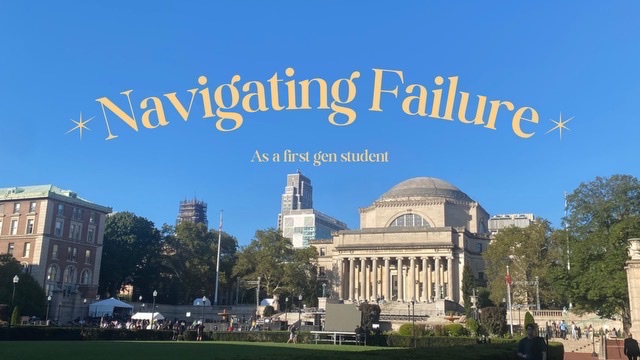
As of today, one day after First-Gen Awareness Day, celebrations have taken place to honor the sacrifices and successes that come with being a first generation student across multiple institutions. In an effort to maintain transparency, I wanted to open up about my own journey. While I wish I could talk about excelling in every class, unfortunately, that’s not the case.
Before transitioning into college, I was unaware of how my background would shape my academic journey. On paper, identifying as a first-generation biracial student committed to pursuing STEM felt empowering, almost effortless.
I naively expected biases and underrepresentation to disappear. “Colleges have seen years of progress, I’m sure biases are a thing of the past,” I reasoned with myself. “With over 50% of students being people of color, the environment will be diverse and inclusive,” I argued.
I continued to debate with myself until I found myself in my first predominantly white class, desperately searching for so much as a crumb of representation. The experiences that followed were interesting to say the least. Incredibly, at a women’s college, I found myself being mansplained to by a male classmate. How did he find the audacity? In my first month, I encountered men audacious enough to assert that women had no place in higher education, implying we should confine ourselves to more “traditional” roles post-graduation—maybe housekeeping. Sound familiar?
I’ve taken on unsolicited advice on what I should or shouldn’t know by now. No, as fundamental as it may seem, I am still learning how to study. Often met with unbelief, “You don’t know how to study? How is that even possible?”
No one warns you about the sense of unpreparedness you feel as a first-generation student from a low-income school pursuing higher education. No one warns you about the sympathetic glances when you struggle with something as seemingly basic as passing a multiple-choice exam or when your first supposedly “easy” exam proves otherwise.
And then there’s failure. Oh my goodness no one prepares you for the comments you get when you fail. Brace yourself for them. “You’re a neuroscience major; how can you not grasp chemistry?” Suddenly, everyone’s an expert on what I should and shouldn’t know at this age. No, I didn’t have the opportunity to take an AP Chem class; my school didn’t offer it. It’s frustrating how some people fail to realize the privilege of attending a school where qualified teachers consistently teach classes. Half the time, I didn’t even know if a course like physics would be offered because my school had trouble finding staff. I’m still figuring out how to study. No, I don’t pass all of my exams in chemistry. Yes, I’m failing my exams.
But it’s not about what you know or don’t know, it’s about what you do with those shortcomings and failures. I know how overwhelming it can be as a first-gen student and if any of these examples sound like you or eerily similar I want this short piece of writing to serve as a reminder that you’re not at your institution because you got “lucky” or because they needed someone of your background. You’re there because you deserve to be there and you’ve worked hard. It’s okay if you fail an exam or don’t know whats being reviewed in your lecture. Professors don’t expect you to know everything, let alone ace every exam. It’s not the failure that matters it’s what you do with the failure and how you recover from it that does. Don’t be afraid to ask questions and take up space. Don’t be afraid to go to office hours. Don’t be afraid to ask for help if you need it.
If you’ve ever had those thoughts that just seem to scream “why am I here I don’t belong here” please remember that you are so much more than a number. You’re a story, a proof , a vision to other little girls or guys that look just like you and come from the same background as you that they too can succeed in these spaces. Your existence, your performance, however good or bad, is already setting up a chain reaction for other students to see themselves in your position and succeed. Regardless of whether you’re aware of it, reading this from your dorm or classroom, you’re occupying a space that is a testament to your potential for success. These numbers are a source of inspiration for younger students, showing them that success is within their reach. Your existence here stands as a powerful reminder that, even in the face of adversity and historical underrepresentation, you have the ability to redefine what it means to succeed despite the barriers that look to confine students of color.
Make a one-time donation
Make a monthly donation
Make a yearly donation
Choose an amount
Or enter a custom amount
Your contribution is appreciated.
Your contribution is appreciated.
Your contribution is appreciated.
DonateDonate monthlyDonate yearly
Leave a comment